It’s 29 degrees. Your AC has been running since noon. The dog is stretched out flat on the kitchen tile, your kid has claimed the single fan in the house, and you’re standing in front of the open freezer pretending that counts. You check the thermostat. It says 26 degrees inside. It has said 26 degrees inside for the past three hours.
Most people in that moment start googling “AC not working Calgary” and hoping for the best. But here’s the thing — if you had a basic sense of what your AC is actually doing in there, you’d probably have spotted the problem days ago, before it turned into a sweltering Thursday afternoon disaster.
You don’t need to know how to fix it. You just need to know what normal looks like.
First, Forget What You Think You Know
Air conditioners do not make cold air. That’s the first thing to get straight. Your AC removes heat from the air inside your home and moves it outside. What comes back through your vents is the same air — just with a big chunk of its heat gone.
Think of a wet sponge. The system soaks up heat from inside your house, carries it outside, wrings it out, and comes back for more. That’s the whole job. Once that lands, everything else about how the system works starts to make actual sense.
The Six Parts That Actually Run Your AC
There’s no mystery here, just six components, each with a specific role.
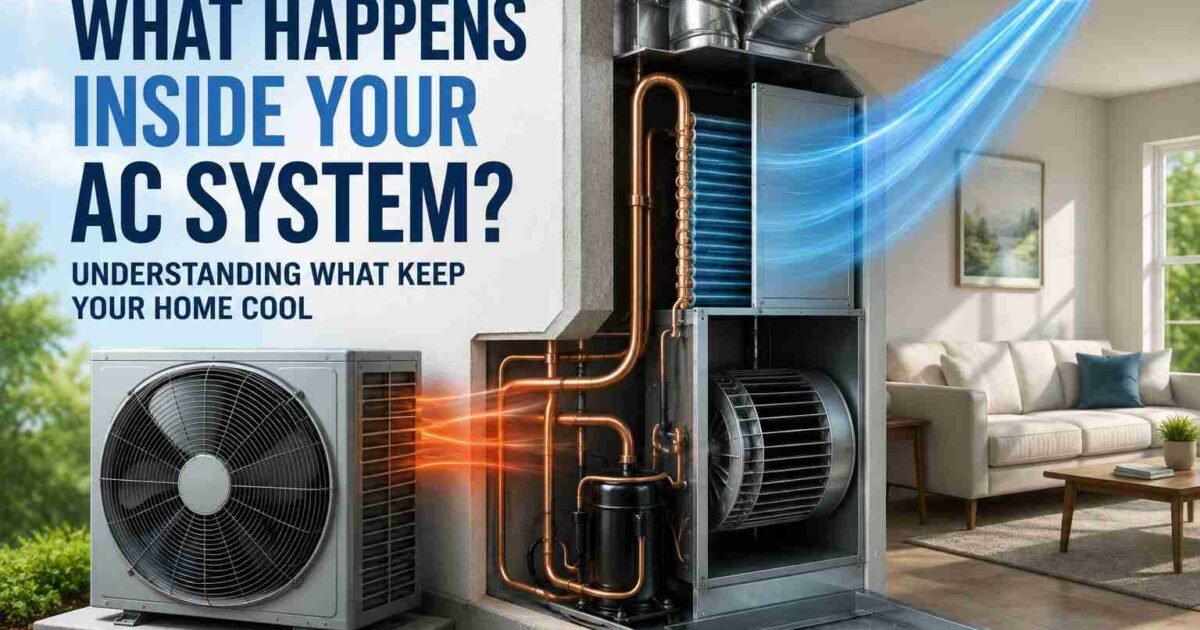
The compressor lives in your outdoor unit and is essentially the muscle of the operation. It pressurises the refrigerant — the fluid doing all the carrying — so it can release heat effectively when it gets outside. When a compressor starts struggling, you usually hear it first. A low hum becomes a clunk. Then a rattle. Then nothing.
The evaporator coil is inside your home, usually sitting above your furnace. Cold, low-pressure refrigerant flows through it. Your warm indoor air passes over it. The heat transfers from the air into the refrigerant. The air comes out cooler and gets pushed back through your supply vents. That’s the part you actually feel.
The condenser coil is outside. The refrigerant — now loaded with heat from your house — flows into this coil. A big fan blows outdoor air across it, and the heat gets released. That hot air blowing out of the top of your outdoor unit? That’s your house’s heat leaving. The system is working.
Refrigerant does the actual carrying. It’s not fuel and it doesn’t burn off. If your refrigerant is low, there’s a leak. That’s the only explanation. It doesn’t evaporate, it doesn’t get used up — it just cycles around endlessly until something lets it out.
The expansion valve does something counterintuitive but important. It drops the refrigerant’s pressure suddenly, which causes a sharp drop in temperature. By the time refrigerant hits the evaporator coil, it’s genuinely cold — cold enough to pull heat out of your indoor air.
The blower fan moves air across the evaporator coil and through your ducts. No movement, no heat transfer. A dirty filter that chokes off airflow doesn’t just slow things down — it sets off a chain of problems that eventually turns into a repair call.

Follow One Breath of Air Through the Whole System
Warm air from your living room gets pulled through a return vent. It travels to the air handler, passes over the evaporator coil, and leaves its heat behind. Cooled air gets pushed back out through your supply vents.
At the same moment, the refrigerant inside that coil — now warm and gaseous — travels to the compressor. Gets pressurised. Gets hot. Moves to the outdoor condenser coil. Dumps the heat. Cools back down. Passes through the expansion valve. Returns to the evaporator coil cold again.
The whole cycle takes seconds. It runs all day. Same refrigerant, same loop, hundreds of times before dinner.
What Actually Breaks — And How Fast It Gets Bad
Capacitors are small cylindrical parts that help motors start and keep running. They fail regularly, especially on systems pushed hard through Calgary heat stretches. A bad capacitor is usually a quick, affordable fix. Leave it too long and the motor it’s connected to burns out — now you’re looking at a much bigger bill.
Refrigerant leaks are the ones that sneak up on people. The system doesn’t stop working overnight. It cools a little less each week. Homeowners turn the thermostat down a degree. Then another. By the time they call someone, the system has been running flat out for months trying to compensate, and the compressor is exhausted.
Iced evaporator coils are almost always a filter story. When airflow drops too low — because the filter’s been clogged for four months — the evaporator coil gets so cold that moisture in the air freezes on it. Now air can’t pass through at all. The system runs, nothing cools, and when the ice melts there’s water on the floor and sometimes inside the air handler itself.
Drainage clogs never seem urgent until there’s a brown stain spreading across a ceiling. The evaporator coil pulls humidity out of the air as it cools — that water needs somewhere to go. If the condensate drain line blocks up, it backs up wherever gravity takes it. Nobody thinks about this one until it’s already a problem.
Calgary Specifically Makes All of This Harder
A lot of AC systems are rated and maintained based on assumptions about moderate, predictable summers. Calgary doesn’t always cooperate. Systems sit cold all spring, then get asked to run twelve hours a day when a heat wave rolls in without much warning. That kind of sudden demand is genuinely hard on components.
The dry, dusty air here clogs filters and coats coils faster than national maintenance schedules account for. Chinooks and shoulder-season temperature swings mean systems cycle on and off more frequently than they would in more stable climates — more cycles, more wear.
A once-a-year tune-up is the standard recommendation most places. Around here, that’s really a minimum, not a ceiling.
What You Can Do Without Calling Anyone
Change the filter every six to eight weeks while the AC is running. Set a phone reminder if that’s what it takes. It is the single highest-return maintenance habit you have, and it costs about twenty dollars.
Keep two feet of clear space around the outdoor unit. Grass and shrubs block airflow through the condenser coil, and a hot condenser that can’t shed heat properly drags the whole system down.
Stop closing vents in spare rooms. It doesn’t save energy — it throws off the pressure balance in your ductwork and makes the system work harder everywhere else.
Once a season, find the condensate drain port near the indoor unit and run a wet-dry vac on it for thirty seconds. Takes less time than making coffee. Prevents water damage.
And don’t crank the thermostat down to 16 trying to cool the house faster. The AC cools at one speed. All you’re doing is making the compressor run longer cycles.
Signs You Shouldn’t Wait On
Warm air from the vents after the system’s been running an hour. Ice on the refrigerant lines or the indoor unit. Sounds — grinding, banging, rattling — that weren’t there last summer. The system turning on and off every couple of minutes without finishing a full cooling cycle. Water pooling near the indoor unit. An electricity bill that jumped without a clear reason. Or the unit just not turning on at all.
None of these resolve on their own. Most get worse the longer they sit.
Rapid Response Heating — Honest AC Work Across Calgary
When the AC goes down in the middle of July, the waiting is the worst part. Rapid Response Heating runs same-day service Monday through Saturday across Calgary — NE, NW, Airdrie, Okotoks, and surrounding areas — with a 24/7 emergency line for the calls that can’t wait until morning. Lead technician Farid and the team are licensed, insured, and carry parts on the van so most repairs get done in one visit.
No hidden charges. No invented problems. You get an honest diagnosis, a straight quote, and the fix done properly. Call (587) 897-0148 or book online at rapidresponseheatingcalgary.com.
The Short Version
Heat moves. That’s all your AC is doing — pulling it out of your home and pushing it outside. Every component exists to make that happen. When one slips, you feel it fast.
Most failures give you a heads-up before they fully quit. Strange sounds, weak airflow, ice, water — these aren’t random. They mean something. Knowing what to look for means catching it early, before the hottest week of the year turns into a three-day repair wait.
Book the spring tune-up. Change the filter on a schedule. And when something feels off, call Rapid Response Heating before it turns into a bigger problem than it has to be.
Frequently Asked Questions
Q1: How often should I change my air filter in Calgary?
Every six to eight weeks during summer is a solid baseline. Pets in the house, or a home that gets dusty quickly — lean toward five or six weeks. Calgary’s dry conditions mean filters load up faster than national schedules assume. The test is simple: pull it out and hold it up to light. If you can’t see through it clearly, it’s past time.
Q2: The AC is running but the house isn’t cooling. What’s going on?
Usually one of four things: a clogged filter cutting off airflow, low refrigerant from a slow leak that’s been building for months, a dirty coil that can’t transfer heat properly, or a compressor that’s running but not pressurising the way it should. These can look similar from the inside. A technician can usually pinpoint it within the first few minutes on site.
Q3: Is water near my indoor unit always a problem?
Some condensation around the drain line is normal — moisture has to go somewhere. Pooling water on the floor, dripping from the unit itself, or wet patches on nearby walls — those mean the condensate drain is blocked. That needs clearing before it causes real water damage to floors, drywall, or whatever’s below it.
Q4: My electricity bill jumped and I haven’t changed anything. Could it be the AC?
Very possibly. A system working harder than it should — low refrigerant, dirty coils, a struggling compressor, clogged filter — draws more power to hit the same result. If the bill jumped noticeably with no other obvious cause, get the AC checked. It almost always reveals something that’s been quietly getting worse.
Q5: How do I know if my refrigerant is low?
A few signs tend to show up together: the air from your vents feels cooler than usual but not actually cold, the system runs longer without hitting your set temperature, or you see ice forming on the refrigerant lines or the indoor unit. Sometimes a faint hissing near the indoor unit too. Worth knowing — refrigerant doesn’t just get used up. If it’s low, there’s a leak. Refilling without fixing the leak is temporary. The level will drop again.