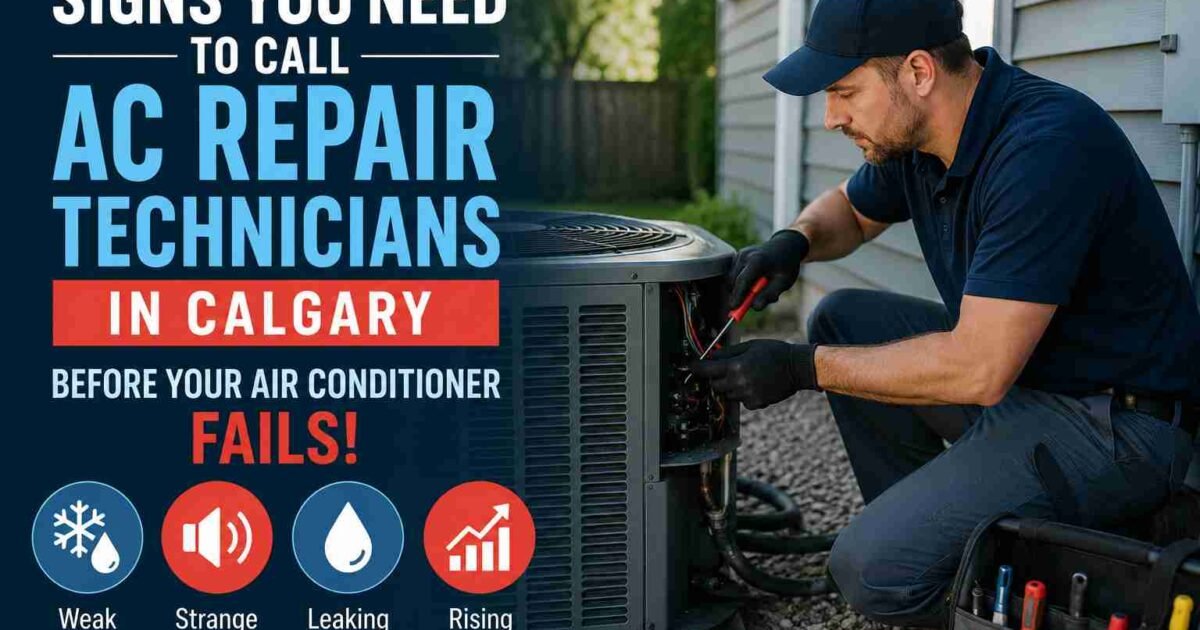
Calgary summers don’t ease in. One week you need a sweater at night, the next you’re running the AC from noon until midnight just to keep the upstairs bearable. And that’s usually when the cracks show. Not all at once — most units don’t just quit cold. They limp along for a while first, giving off small signals that something’s off.
The problem is, those signals are easy to talk yourself out of. A little extra rattle. A room that’s warmer than it should be. A power bill that crept up twenty bucks, and you shrugged it off. None of it feels like an emergency — until the day it actually stops cooling, usually smack in the middle of the first real heatwave. That’s when half of Calgary is calling AC repair technicians at once, and you’re stuck waiting behind everyone else whose unit picked the same week to die.
So here’s the rundown: the signs that actually matter, why they show up, and what they usually mean. This comes straight from the kind of calls Rapid Response Heating fields every summer across Calgary — Redstone, Coventry Hills, Evanston, Airdrie, all over.
Why Early Warning Signs Actually Matter Here
Calgary’s cooling season is short. That’s part of the problem. A unit sits idle most of the year, then gets asked to run flat-out the second it hits 28 degrees. That stop-start pattern is brutal on parts that have already been quietly wearing down without anyone noticing.
A minor issue in June turns into a dead system by August, more often than people expect. And once it’s fully out, you’re not just sweating it out for a few days — you’re usually paying more for the emergency callout than you would’ve for the simple fix months earlier. Good home air conditioning service in Calgary isn’t really about fixing what’s broken. It’s about catching the small stuff before it becomes the big stuff.
Your AC Won’t Turn On, or It’s Not Starting Right
This one’s obvious once it happens, but the early version is sneakier. The thermostat is set fine, but nothing happens. Or the breaker trips every single time it tries to kick on. Sometimes there’s a clicking noise — like it’s trying — but it never actually gets to cool anything.
Usually that’s electrical. A capacitor on its way out, a wiring problem, a thermostat that’s stopped talking to the unit properly. Not a DIY job, and definitely not something to just keep restarting and hoping. A unit that keeps trying and failing to start is putting real strain on the compressor every time.
The Air’s Coming Out Warm, Not Cold
A healthy AC gives you a real temperature drop at the vent — you should feel it immediately. If the air’s barely cooler than the room, something’s not working, even if the unit sounds totally normal doing it.
Could be low refrigerant from a slow leak. Could be a compressor that’s struggling. Could be airflow getting blocked somewhere in the system. Whatever it is, running it longer “to catch up” is rarely the answer — that just pushes more strain onto a compressor that’s already having a rough time.
Weird Noises, Weird Smells, Water Where It Shouldn’t Be
Every AC makes some noise. There’s a difference between the usual hum and a new bang, squeal, or rattle that wasn’t there last week. Same with smells — musty when it kicks on, or anything that smells faintly like something burning. Worth checking, not ignoring.
Water’s another giveaway. Pooling near the indoor unit, or ice actually forming on the coil — both point to something real. Restricted airflow, low refrigerant, a clogged drain line. Frozen coils and refrigerant leaks show up on a lot of Calgary service calls, usually right as the weather turns and the system’s asked to do more than it’s done all year.
Some Rooms Never Cool Down, No Matter What
If one room’s always a few degrees behind the rest of the house, or airflow’s noticeably weak at certain vents but fine elsewhere — that’s nothing. Sometimes it’s ductwork. Sometimes the system was never quite sized right for the house to begin with. Sometimes it’s a blower motor losing steam.
Not always urgent. But it’s the kind of thing that’s a lot easier to sort out in May than it is in the middle of a heat warning with the whole family sweating it out in the back bedroom.
Your Bill’s Climbing and Nothing Else Has Changed
If the cooling bill keeps creeping up and you haven’t changed how you use the AC at all, pay attention. Usually means the system’s working harder for the same result — dirty coils, low refrigerant, a part that’s lost efficiency.
Easy to write off as “just a hot summer.” But a proper tune-up often brings that number right back down, and it tends to pay for itself before the season’s even over.
When’s the Last Time Anyone Actually Looked at It?
A lot of AC trouble traces back to maintenance that just never happened. The filter never changed. Coils never cleaned. Refrigerant never been checked in years. None of it looks like a big deal on its own. Add it all up, though, and you’ve got a system that’s a lot more likely to fail without warning.
An annual check covers the basics — new filter, coil cleaning, refrigerant levels, an efficiency test, thermostat calibration. Small cost, and it usually beats the alternative: an emergency repair bill in the middle of July.
What Actually Happens When You Call Rapid Response Heating
Calling shouldn’t feel like rolling the dice. When people reach out to Rapid Response Heating, they get a technician who actually looks at the system and explains what’s wrong in plain language — not a sales pitch dressed up as a diagnosis. Pricing’s clear before anything starts. No pressure to buy more than you need. Sometimes it’s a quick fix, sometimes it’s a maintenance visit, sometimes it’s an honest conversation about whether the unit’s near the end of its life. Same-day appointments are available for most calls, which matters a lot when the forecast’s ugly and the house is already getting warm.
Final Thoughts
An AC rarely fails out of nowhere. Slow starts, warm air, new noises, uneven cooling, a climbing bill, maintenance that’s fallen behind — all of it’s worth acting on before the system fully quits. Catching it early saves you the hot, miserable house. It usually saves money, too, since a repair almost always costs less than an emergency replacement in July.
If any of this sounds familiar, get someone to look at it before the next heatwave puts real pressure on the system. Rapid Response Heating offers same-day home air conditioning service across Calgary, with licensed technicians who tell you what’s actually wrong instead of guessing. Call (587) 897-0148 to book, or request a free estimate online — before your AC picks the worst possible moment to give out.
Frequently Asked Questions
- How do I know if my AC needs a repair or a full replacement?
Depends on the age of the unit, how often it’s already needed fixing, and what the repair costs stack up to against a new system. A technician can walk you through the actual condition of the unit rather than pushing a replacement you don’t need yet. - Is it normal for my AC to freeze up?
No. A frozen coil usually means restricted airflow, low refrigerant, or a fan issue. Running it frozen just causes more damage — better to shut it off and get it looked at than wait for it to thaw and hope it sorts itself out. - How often should I get my AC serviced in Calgary?
Once a year, ideally in spring before the season kicks off, covers most homes. Regular checks catch things like low refrigerant or dirty coils before they turn into a breakdown mid-heatwave. - Can a dirty air filter really cause all this?
Yes, more than people expect. A clogged filter restricts airflow, which leads to weak cooling, frozen coils, and a system working harder than it needs to. One of the simplest things to check and one of the most common causes of avoidable service calls. - Do you offer same-day AC repair in Calgary?
Yes — same-day appointments for most AC repair calls across Calgary and the surrounding communities, with emergency service available when a system gives out during extreme heat.